Education & Productivity: May 2026 Growth Guide

If you’re a marketer, creator, or app founder in the Education & Productivity niche, this guide is for you.
It will update on trending formats, viral hooks, and new apps, giving you the tools you need to plan your strategy for the month ahead:
- An overview of what happened in the last 30 days
- Top hooks and formats to test in May
- The hottest breakout accounts and apps
- Access to a full list of hundreds of videos you can explore with our advanced analytics
Use it to spot trends early, borrow what’s already working, and avoid wasting time on outdated formats.
Let’s get started.
Niche Overview
Views
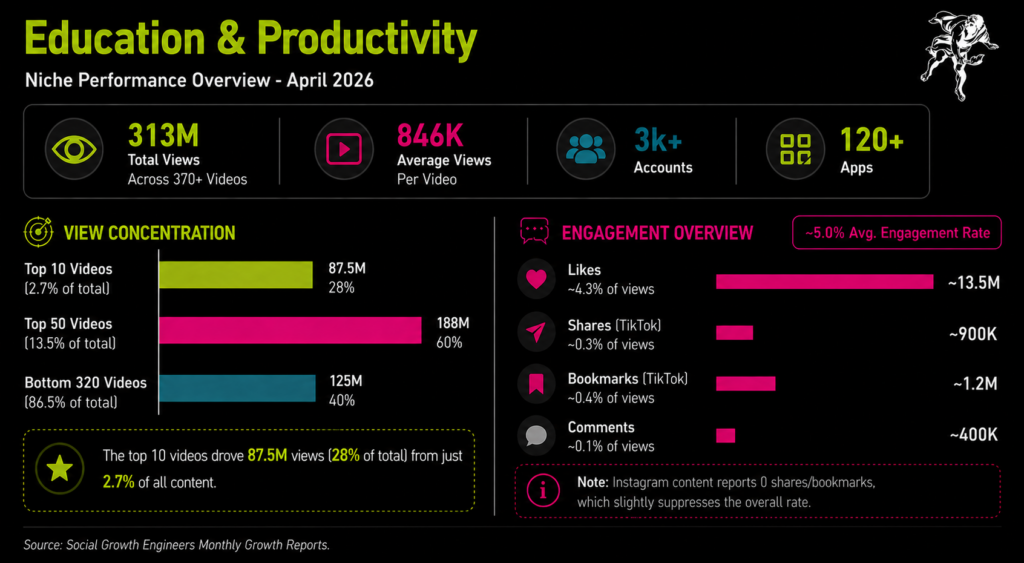
Over the last 30 days, the Education & Productivity niche generated 313M views across 370+ videos (846K average views per video).
Content spans TikTok, Instagram Reels, and YouTube Shorts, with TikTok clearly dominating by volume.
Language learning apps (Fluently, HelloTalk, Stimuler, Voca AI) lead the Education vertical, while AI productivity tools (Blackbox, Blow Up, Summary AI, Bloom) anchor Productivity.
Performance is heavily top-weighted. The top 10 videos alone drove 87.5M views (28% of total) from just 2.7% of all content.
The top 50 videos accounted for 60% of total views (188M), while the remaining 320 videos generated 40% (125M), indicating a broader mid-tier distribution compared to more winner-take-all niches.
This suggests a more balanced discovery curve, where a larger pool of creators and formats is able to capture meaningful traction beyond just breakout hits.
Engagement
Overall engagement lands at 5.0% across the niche (16M total interactions), significantly lower than the Religion & Faith niche, and driven primarily by likes (13.5M). Shares (900K), bookmarks (1.2M), and comments (400K) play secondary roles.
The Education vertical (5.6% ER) outperforms Productivity, largely driven by language learning content that generates high-intent engagement. Select creators achieve strong likes and shares ratios, indicating active consumption and saving behavior.
The Productivity vertical (3.9% ER) is pulled down by two key factors: ads-heavy content with suppressed interaction rates, and coding/AI videos attracting more passive audiences.
Despite this, strong organic performers within both verticals indicate that high-intent, utility-driven content still converts into meaningful engagement when executed well.
Top Hooks & Formats to Test
- “corporate hack !!!”
From: Summary AI
Hook type: Hack tease
- 11.4M views
- 0.2% engagement
Format: Quick hack demo
Type: Face
What it looks like: Straight to the screen, no talking head, no intro. Shows the AI taking meeting notes in real time. Pure utility, in and out.
2. “Bestie”
From: Fluently
Hook type: Visual pull (uses a single word to build up the video context)
- 9.8M views
- 1.7% engagement
Format: Visual explanation video
Type: Face
What it looks like: Blink-and-you-miss-it content. Feels more like a mood or a vibe than a tutorial, the app appears naturally inside a relatable scene. No explanation, no demo. Just feeling.
3. “I wish I had this app earlier💔”
From: Fluently
Hook type: curiosity/fomo hook
- 8.4M views
- 2% engagement
Format: App/use case display
Type: Face
What it looks like: The reel lets the aesthetic and relatable scenario do all the work by showing the app demo and use case simultaneously.
4. “Why is English still so hard? 😭 😭 😭”
From: BoldVoice: Accent Training
Hook type:
- 5.4m views
- 11.2% engagement
Format: Learning skit
Type: Face
What it looks like: Creator speaks directly to the camera, demonstrating accent or pronunciation sounds like a mini lesson you didn’t know you needed. Personal, instructional, funny, and easy to bookmark for later.
5. “pov: when students don’t realize you can watch an instant playback of their writing”
From: GPTZero
Hook type: POV authority flip
- 4.58M views
- 6.3% engagement
Format: Disappointing reaction + app demo
Type: Face
What it looks like: Teacher’s phone or screen shows the app replaying a student’s exact writing session in real time. No talking, no setup, just the tool doing something students don’t expect. Proof over explanation.
6. “ATTENTION 2026 AP STUDENTS 📣”
From: PrepGo: AP® Exam Prep
Hook type: Direct call-out:
- 4.42M views
- 1% engagement
Format: Explaination video
Type: Face
What it looks like: Creator speaks directly to the target audience, like a study session or school announcement. Structured, practical, and paced for students already in exam-prep mode.
7. “SEND THIS VIDEO TO SOMEONE OLDER TO SHOW RESPECT”
From: Teuida: Learn Languages
Hook type: Call to Action (CTA) / relational hook
- 2.81M views
- 6.4% engagement
Format: Cultural lesson reel
Type: Face
What it looks like: Demonstrates respectful phrases or gestures in multiple languages in under 20 seconds. Feels like something you’d immediately forward to a family group chat, which explains the share behavior.
8. “Me writing down every formula I memorized as soon as the exam starts before it escapes my brain”
From: Brainly: AI Homework Helper
Hook type: Hyper-relatable student moment
- 2.70M views
- 26.7% engagement
Format: Short relatable meme
Type: Face
What it looks like: In a fast-moving video, a person replicates a relatable educational moment.
Apart from these top-performing hooks, here’s a detailed collection of almost 400 hooks that are performing well in this niche.
Breakout Accounts & Apps
GPTZero
GPTZero’s growth came from turning AI detection into social conflict, not just a utility demo.
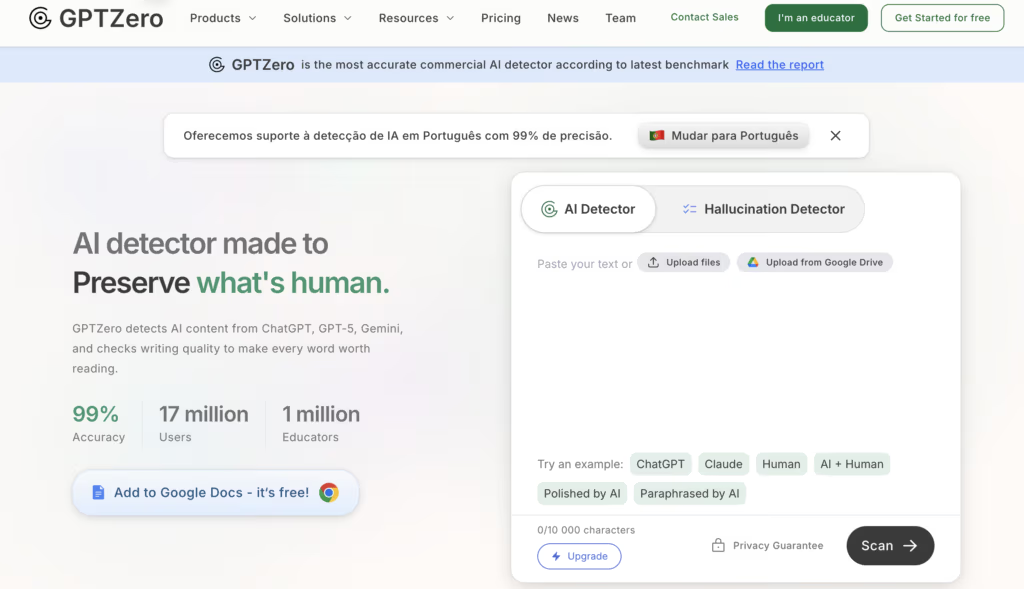
Student creators framed the tool as a way to defend themselves when accused of cheating, while teachers used it from the opposite angle, showing how they identify AI-written work, which gave the content a much broader reach than a typical study app.
Mentiora
Mentiora is gaining traction by making academic frustration the real hook and keeping the product reveal until the end.
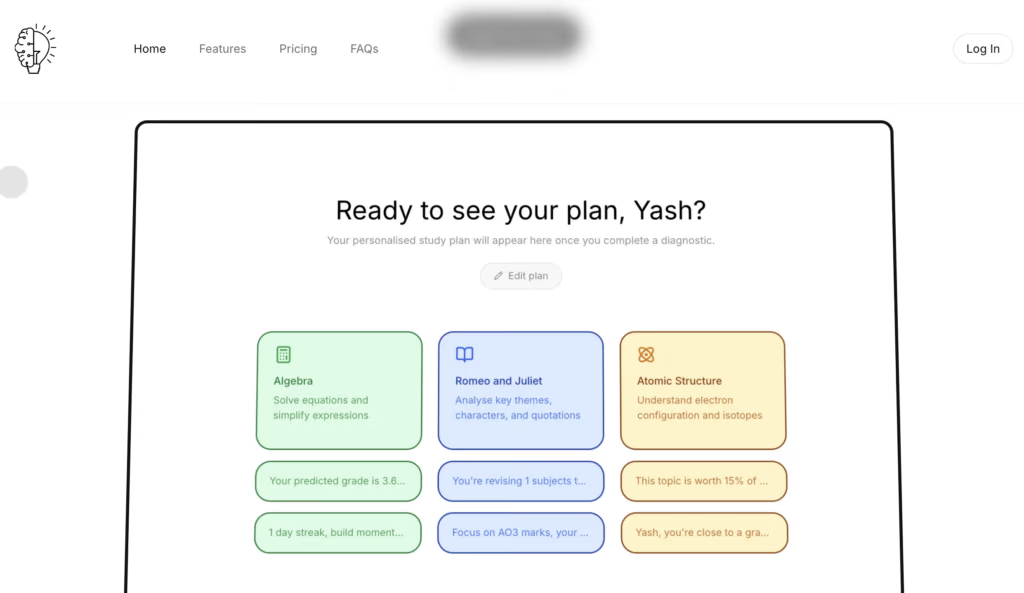
The strongest videos lean into exaggerated study pain, jokes about giving up, and emotionally familiar student moments, which makes the app feel like the answer rather than the subject.
Wiingy: Find the Best Tutor
Wiingy’s content works because it barely starts as tutoring content at all.
The strongest posts use breakup drama, burnout, and personal confession-style storytelling first, then quietly connect those emotions back to language learning or skill-building, which makes the app feel embedded inside the story rather than forced into it.
Kollegio
Kollegio sits in the university admissions space, but the content tension comes from how hard it is to make college guidance feel native to TikTok.
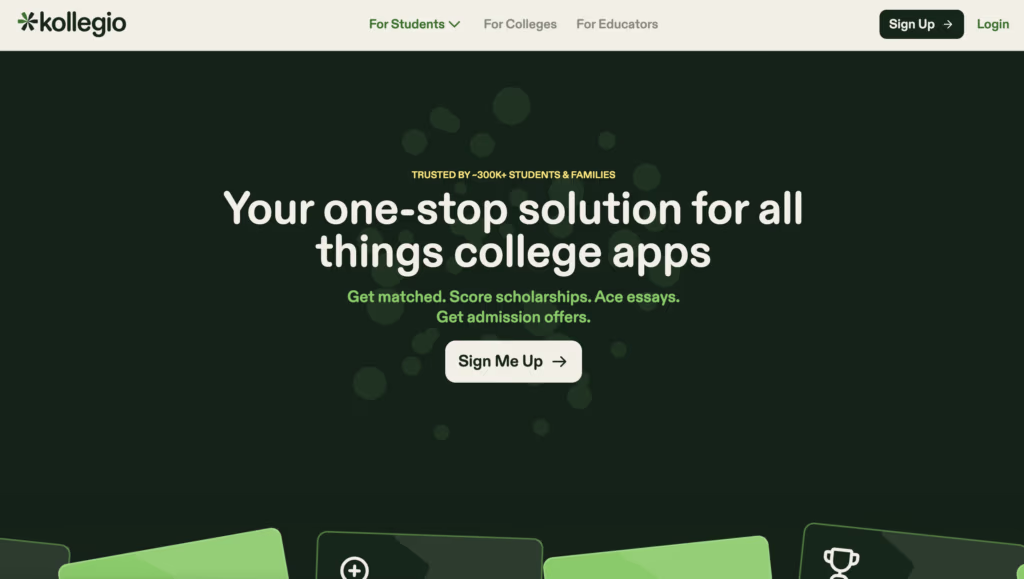
Product-led videos and college-list slideshows can pull attention, but the bigger takeaway is that student-life content tends to perform better when it feels messy, personal, and socially recognizable instead of overly polished.
ScrollToStudy: Study Assistant
ScrollToStudy grew through a low-cost, faceless slideshow system built around curiosity hooks, numbered study tips, and a soft product mention placed inside the sequence.
The model shows how a simple repeatable format, plus strong comment-section signaling, can generate millions of views without relying on heavy editing or large creator networks.
Newcomers to Watch
Focus Town: Study With Friends
Focus Town is a recently launched social study app that turns studying into a shared, game-like experience, and its first real creator push moved fast.
In just over a week, hundreds of UGC videos established two early winning angles: one framed the app as a cozy Gen Z study world, while the other sold it more directly as an accountability tool for staying focused with friends online.
Snitchnotes
Snitchnotes is still in a testing phase, but the setup already shows how some early study apps approach distribution.
Instead of relying on one clear brand voice, it spreads experiments across multiple accounts, trying different audience angles and content styles while slideshows appear to be emerging as the strongest format so far.
Bragi – Language Learning
Bragi is an early-stage language app using a more layered content system than most newcomers.
Rather than pushing a single repetitive format, it mixes multiple creator and account styles, which helps the app feel less one-dimensional while still building momentum around a clear language-learning identity.
Zensi – AI Screen Time Control
Zensi is one of the newest productivity apps showing signs of traction on StudyTok, even with a small creator base.
The early signal is not massive scale yet, but a borrowed competitor-style format that produced unusually strong engagement, suggesting the app may have found a creative angle that resonates before fully breaking out.
Resources & Next Steps
Every month, we also put out fresh resources designed to save you time, help you stay ahead of the game, and ensure that every piece of content you create has a genuine chance of going viral (and converting).
Dive into our full hooks dataset for ideas that are already winning, explore 50+ faceless formats that are easy to adapt and scale, or check out our How-to TikTok Guide if you’re new to the platform.
In case you’re struggling with turning views into real results, our TikTok Marketing Funnel walks you step-by-step through increasing conversions and growing your app or brand faster.
Access the full resource collection here.
63k Education & Productivity Hooks Dataset
We’ve compiled over 63,000 viral hooks from 700+ successful accounts and creators. Sort them by face or faceless, video or slideshow, and even by language. Captions and sound included.

About Social Growth Engineers
Social Growth Engineers is a growth-focused research and content platform built for consumer apps.
We analyze what’s working in organic distribution across short-form platforms, from viral formats and content strategies to deep-dive playbooks.
Our goal is to expose what’s out there and help founders and marketers grow smarter and faster.
For more daily insights, trends, and bite-sized hacks, follow us on X, LinkedIn and YouTube (here and here).